Shop All Exterior Doors

Choosing the right interior door core is an important decision that affects durability, sound control, and long-term performance. While solid core and engineered core interior doors may look similar from the outside, their internal construction creates meaningful differences in how they perform in everyday use.
This guide explains the key differences between solid core and engineered core interior doors, helping you understand which option best suits your space, expectations, and project requirements.
This updated guide includes the latest 2026 technical standards, design trends, insulation performance updates, and durability insights, helping you make the most informed decision.
Interior door performance is largely determined by what’s inside the door, not just the surface design. The core material influences weight, stability, sound insulation, and how the door holds up over time.
Both solid core and engineered core doors are designed to offer better performance than hollow core doors, but they achieve this through different construction methods.
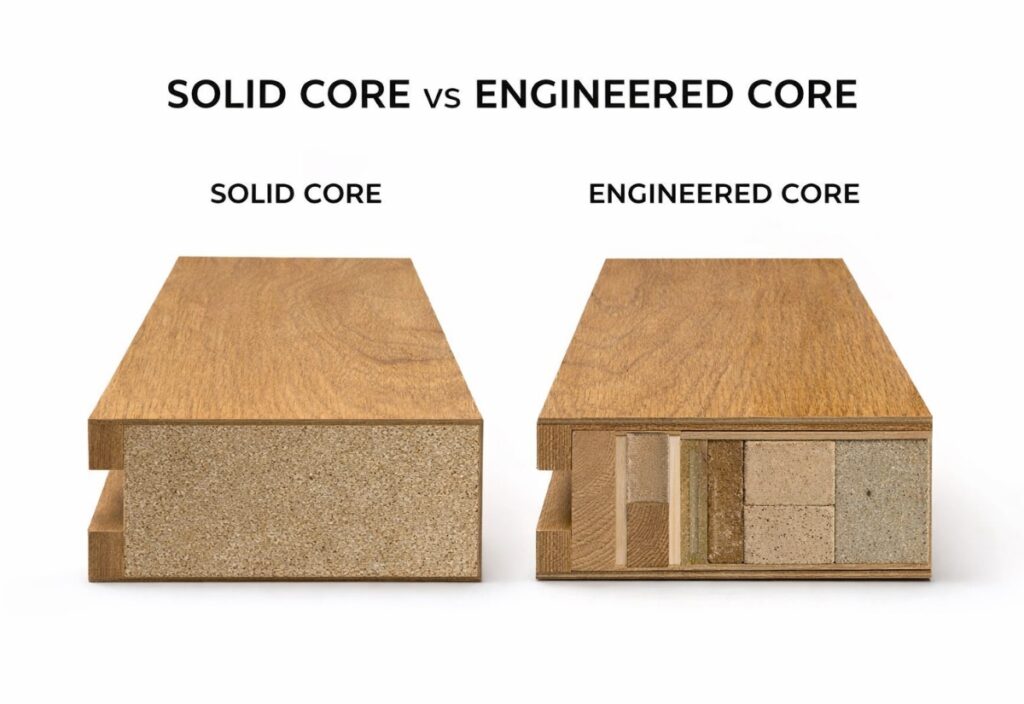
A solid core interior door is built using a dense core material, commonly made from composite wood or particleboard. This dense interior gives the door a heavier, more substantial feel and improves sound reduction between rooms.
Because of their weight and density, solid core doors are often chosen for spaces where privacy matters, such as bedrooms, offices, and shared living areas. The added mass helps reduce noise transfer and provides a more solid, traditional door experience.
Solid core doors are valued for their durability and familiar feel, making them a reliable option for residential interiors that prioritize sound control and long-term use.
Engineered core interior doors use a layered internal structure designed to balance strength, stability, and efficiency. Instead of relying on a single dense mass, engineered cores combine materials in a way that improves consistency and reduces the risk of warping over time.
This construction approach allows engineered core doors to remain lighter than solid core doors while still delivering strong performance. Their stability makes them especially suitable for modern interiors and larger projects where uniformity and ease of installation are important.
Engineered core doors are commonly used in contemporary residential and commercial spaces that require reliable performance without excessive weight.
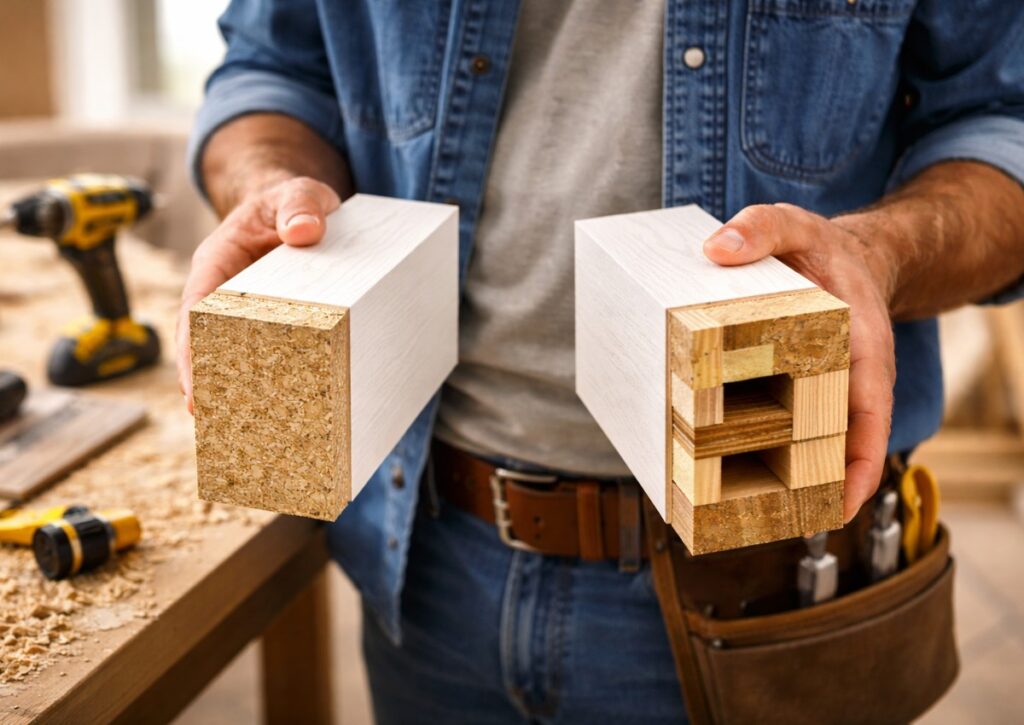
While both door types offer improved performance over hollow core options, their differences become clear when comparing how they behave in real-world conditions.
Solid core doors typically provide slightly better sound reduction due to their dense construction. However, this density also makes them heavier, which can affect handling and installation. Engineered core doors, on the other hand, focus on dimensional stability and consistency, making them less prone to movement caused by temperature or humidity changes.
In short, solid core doors emphasize mass and sound control, while engineered core doors prioritize balance, stability, and efficiency.
If sound insulation and a heavier, more traditional door feel are your top priorities, a solid core interior door may be the better choice. These doors work well in private rooms where noise control and durability are important.
If your project values consistency, ease of installation, and modern construction methods, an engineered core interior door may be more suitable. Their balanced design makes them ideal for whole-home applications and projects where long-term stability is essential.
Understanding how each core type is constructed helps ensure your interior doors perform as expected over time.

To explore the technical details behind each door type, you can review our in-depth construction guides:
These resources provide detailed insight into materials, internal structure, and performance characteristics.
Kally LTD offers:
Canadian-made solid core & engineered core interior doors
Precision-built door cores for better sound control & durability
Custom sizes, trims, and frame compatibility
Fast delivery across Toronto & the GTA
Expert guidance for choosing the right interior door construction
Explore our collections:
Fill out the form below, and we will be in touch shortly.
Fill out the form below, and we will be in touch shortly.